3D Printing Revolution: Sustainable Fashion Manufacturing in the US by 2025
Anúncios
3D printing is poised to revolutionize sustainable fashion manufacturing in the US by 2025, offering localized production, reduced waste, and innovative materials, thus transforming the industry’s environmental impact and supply chain dynamics.
Anúncios
The fashion industry is notorious for its environmental impact, but 3D Printing: Revolutionizing Sustainable Fashion Manufacturing in the US by 2025 offers a promising solution. By embracing this technology, the US fashion sector can significantly reduce waste, localize production, and pioneer eco-friendly materials.
3D printing: A game-changer for sustainable fashion
3D printing, also known as additive manufacturing, is transforming industries by enabling the creation of three-dimensional objects from digital designs. In the fashion world, this technology presents a unique opportunity to address sustainability challenges.
Anúncios
Reducing waste with 3D printing
Traditional fashion manufacturing often involves cutting and sewing, leading to significant fabric waste. With 3D printing, garments are created layer by layer, minimizing material waste and promoting a more circular economy.
Localized production and on-demand manufacturing
3D printing empowers businesses to produce clothing locally and on-demand, reducing the need for long supply chains and minimizing carbon emissions associated with transportation.
- Reduce carbon footprint by minimizing garment transportation.
- Facilitate localized production, boosting local economies.
- Enable personalized and customized designs efficiently..
3D printing allows designers to create complex and intricate designs that would be impossible to achieve with traditional methods. This opens up new possibilities for innovation and creativity in fashion.

The integration of 3D printing in fashion design is not merely about creating novelty items; it represents a fundamental shift towards more responsible and resource-efficient practices.
The environmental benefits of 3D-printed fashion
One of the most significant advantages of 3D printing in fashion is its potential to reduce the industry’s environmental impact. Let’s explore some of the key environmental benefits.
Minimizing textile waste
The fashion industry is a major contributor to textile waste, with tons of unwanted clothing ending up in landfills each year. 3D printing can significantly minimize waste by producing only what is needed, eliminating excess inventory and reducing disposal.
Reducing water consumption
Traditional textile manufacturing processes are water-intensive, requiring vast amounts of water for dyeing and finishing fabrics. 3D printing reduces water consumption, as it involves a dry manufacturing process.
By adopting 3D printing, fashion brands can reduce their reliance on water-intensive manufacturing processes and minimize their impact on water resources. This shift aligns with global efforts to conserve water and promote sustainable water management.
- Reduction of water consumption in the manufacturing process.
- Less use of harmful chemicals traditionally used in textile dyeing.
- Lower energy consumption compared to traditional methods.
The ability to create complex and intricate designs with minimal material waste sets 3D printing apart as a sustainable alternative in fashion. This technological advancement opens doors for designers to push the boundaries of creativity while maintaining environmental responsibility.
Innovate materials: The key to sustainable 3D-printed fashion
The sustainability of 3D-printed fashion relies heavily on the materials used in the printing process. Innovate materials are emerging as a game-changer in this field.
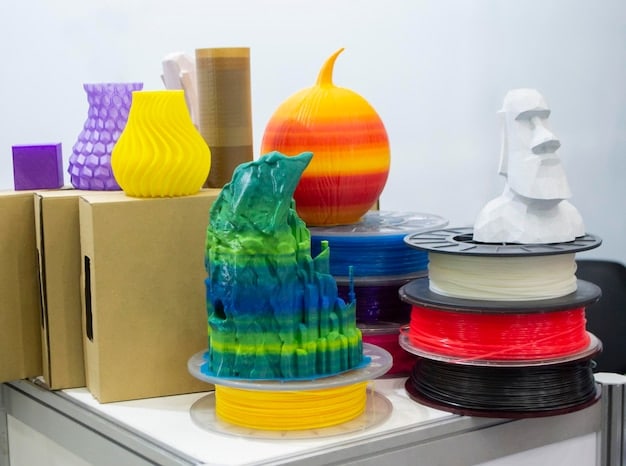
Recycled plastics and sustainable filaments
One of the most promising avenues for sustainable 3D printing is the use of recycled plastics and sustainable filaments. These materials offer a way to repurpose waste and reduce the demand for virgin resources.
Bio-based materials and natural fibers
Bio-based materials, such as algae, wood pulp, and agricultural waste, are also gaining traction in the 3D printing world. These natural fibers can be used to create biodegradable and compostable garments.
As the demand for sustainable fashion grows, expect to see even more innovative materials emerge in the 3D printing landscape. These materials will not only reduce the environmental impact of fashion but also open up new design possibilities.
- Utilize sustainable resources, reducing reliance on extraction.
- Create garments that can decompose safely after use.
- Reduce carbon emissions associated with traditional material production.
Experimenting with diverse materials allows for the creation of garments with unique textures, flexibility, and durability, thereby enhancing the functionality and appeal of 3D-printed fashion items.
Challenges and opportunities for 3D printing in US fashion
While 3D printing holds immense potential for revolutionizing sustainable fashion manufacturing in the US, it’s essential to acknowledge the challenges and opportunities that lie ahead.
Scalability and cost considerations
One of the main challenges is scalability. 3D printing is still a relatively slow and expensive process compared to traditional manufacturing methods. Overcoming this barrier requires investment in advanced 3D printing technologies and streamlining the production process.
Design limitations and material options
Another challenge is the limited design options and material choices available for 3D printing. While the technology has advanced significantly, it’s still not as versatile as traditional manufacturing in terms of design complexity and material properties.
Addressing these challenges requires collaboration between designers, engineers, and material scientists to develop new 3D printing techniques and expand the range of sustainable materials available. By embracing innovation and investing in research and development, the US fashion industry can overcome these obstacles and unlock the full potential of 3D printing.
- Lower initial investment for small-scale production.
- Opportunity to create custom and personalized fashion items.
- Potential for on-demand manufacturing, reducing inventory costs.
The integration of 3D printing presents an opportunity for the US fashion industry to regain its competitive edge by focusing on niche markets, customized solutions, and sustainable practices.
The role of technology and infrastructure in advancing 3D printing
Advancing 3D printing in the US fashion industry requires a robust technology and infrastructure ecosystem. Investing in research and development, fostering collaboration, and promoting education are essential for driving innovation and adoption.
Government support and incentives
Government support can play a crucial role in advancing 3D printing in fashion. Incentives such as tax breaks, grants, and funding for research and development can encourage businesses to invest in this technology and accelerate its adoption.
Collaboration and industry partnerships
Collaboration between fashion brands, technology companies, and research institutions is essential for driving innovation in 3D printing. By sharing knowledge, resources, and expertise, stakeholders can overcome challenges and accelerate the development of sustainable 3D-printed fashion solutions.
By fostering a supportive ecosystem and investing in technology and infrastructure, the US can position itself as a leader in sustainable 3D-printed fashion manufacturing.
Creating a framework that supports technological innovation, material development, and workforce training is critical to advancing 3D printing in the fashion sector. It is necessary to create an environment where startups and established companies can thrive, fostering economic growth.
Predictions for the future of 3D printing in fashion by 2025
By 2025, 3D printing is expected to play a significant role in transforming sustainable fashion manufacturing in the US. Let’s explore some predictions for the future of this technology in the fashion industry.
Widespread adoption of 3D printing
As the technology matures and costs decrease, we can expect to see a widespread adoption of 3D printing in the fashion industry. More and more brands will incorporate 3D printing into their manufacturing processes, offering consumers sustainable and customized fashion options.
New business models and supply chain innovations
3D printing will enable new business models and supply chain innovations in the fashion industry. On-demand manufacturing, personalized designs, and localized production will become more prevalent, reducing waste and improving efficiency.
By 2025, 3D printing is poised to revolutionize sustainable fashion manufacturing in the US, offering a pathway towards a more circular, responsible, and innovative fashion industry. The convergence of technology, materials, and design will redefine how garments are created, consumed, and recycled, paving the way for a more sustainable future.
- Creation of personalized garments based on individual measurements.
- Establishment of micro-manufacturing hubs for localized production.
- New revenue streams through digital designs and customization services.
With continued advancements in technology, materials, and design, 3D printing will play a significant role in transforming the fashion industry, making it more sustainable, personalized, and efficient.
| Key Point | Brief Description |
|---|---|
| 🌱 Sustainable Materials | Using recycled and bio-based materials reduces environmental impact. |
| 🏭 Localized Production | Manufacturing closer to consumers cuts down on transportation emissions. |
| 🗑️ Waste Reduction | 3D printing minimizes fabric waste by creating garments layer by layer. |
| 💼 Customization | Enables personalized garment designs based on individual preferences. |
FAQ
▼
3D printing reduces textile waste by creating garments layer by layer based on precise digital designs, minimizing excess material and eliminating cutting scraps common in traditional methods.
▼
Sustainable materials in 3D printing include recycled plastics sourced from ocean waste, bio-based filaments like algae or wood pulp, and innovative materials developed from agricultural byproducts.
▼
Localized production cuts down on lengthy supply chains, reducing emissions from transportation and ensuring products are made closer to consumers, supporting local economies and creating regional jobs.
▼
Challenges include scalability limitations, the initially high cost of technology, and the still relatively limited range of materials and design options compared to conventional fashion manufacturing processes.
▼
Governments can offer tax incentives, fund research and development initiatives, support workforce training programs, and incentivize partnerships between fashion brands, technology companies, and research institutions.
Conclusion
3D printing is set to reshape the US fashion industry by 2025, offering a more sustainable, efficient, and innovative approach to manufacturing. By addressing challenges and leveraging opportunities, the US can become a leader in sustainable fashion, reducing waste, promoting localized production, and embracing innovative materials.